Where Does Slab Tip-Over Risk Exist in Your Operation?
Every slab operation has three high-risk zones. Identify yours.
🚚 Transport & Delivery Risk
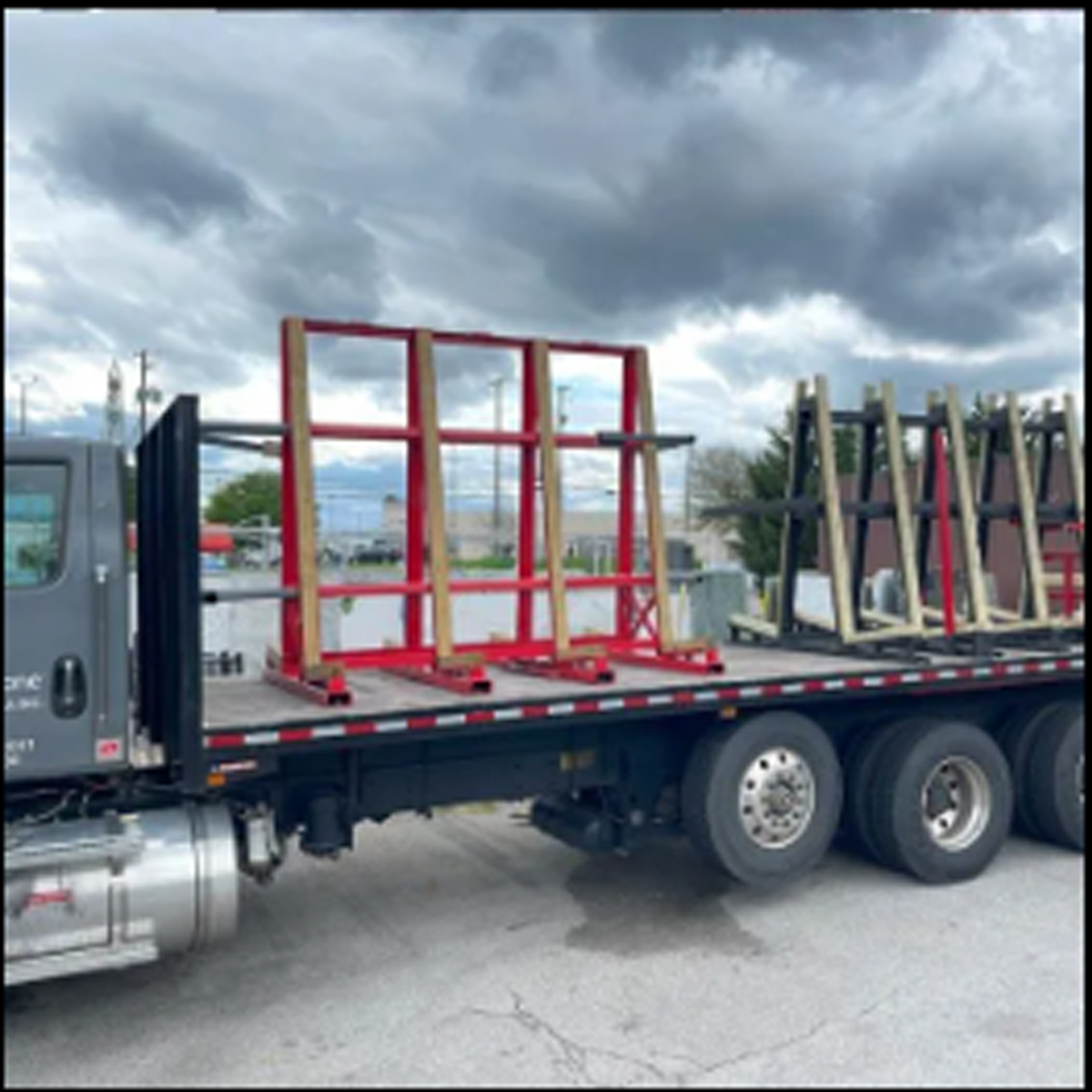
Sudden stops. Road vibration. Load shifts.
Over-center events during loading and unloading can begin long before the jobsite.
Movement during transit introduces dynamic forces that traditional restraints were never designed to manage.
🏢 Warehouse & Yard Risk
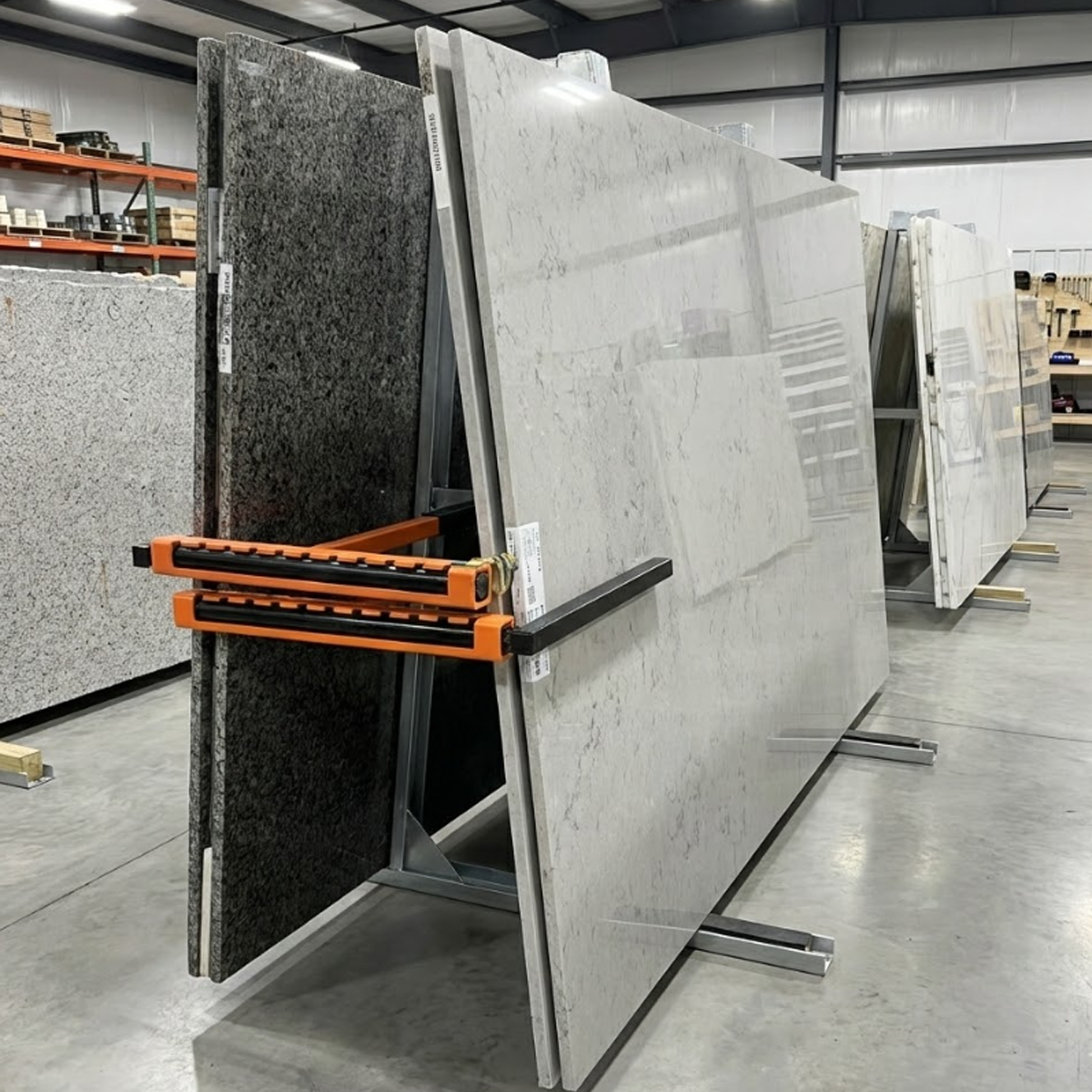
Staging movement. Forklift contact.
Uneven surfaces.
Slabs tipping during routine handling is one of the most underestimated hazards in fabrication environments.
Instability often begins during repositioning, not impact.
🏢 🛠 Container Unloading Risk

Bundle shifts during overseas transit.
First-movement instability during unloading is where inherited risk becomes your liability.
Once bracing is removed, stored tension can convert into sudden rotational force.
See How Engineered Controls Change the Risk Equation
Rather than reacting to movement after it begins, engineered mechanical control systems stabilize slabs at the highest leverage point — before rotation starts.
▶ Watch how structural restraint replaces reactive strapping and manual guesswork.
⚠️ Where Slab Tip-Over Incidents Actually Happen
Slab failures rarely occur because someone “wasn’t careful.”
They occur when routine handling crosses the mechanical over-center tipping threshold.
High-risk trigger moments include:
First movement after overseas transit
Sudden deceleration during transport
Forklift contact or staging adjustments
Improvised or light-duty A-frame systems
When center of gravity passes the tipping line, reaction time disappears.
📉 Industry Reality
Across transport, storage, and installation environments, slab tip-over incidents have resulted in:
Severe worker injury
Fatalities
Product loss
Operational shutdowns
OSHA citations
Litigation and insurance exposure
These are not rare anomalies.
They occur during routine workflow conditions.
🎥 Reported Incidents in the Industry
Documented examples of slab tip-over events:
Two workers crushed at Stone Warehouse of Michigan.
Huntsville Granite cited for fatal slab accident.
Semi-truck granite spill on I-24 causing major traffic disruption
Survivor crushed by 10,000 lb slab requiring extensive reconstructive surgery
These cases illustrate a consistent pattern: instability begins before impact.
🛠 Engineering Controls, Not Reactionary Fixes
Slab safety cannot depend on perfect conditions or perfect timing.
Effective control systems must be engineered directly into the handling process.
RockLock™ systems were designed to:
Establish a fixed mechanical barrier against over-center rotation
Integrate into real-world truck, warehouse, and container workflows
Replace tension-based guesswork with structural restraint
Deliver consistent control across loading, transit, staging, and unloading
Core System Capabilities
Patented RockLock™ Adjustable Arm Safety System
Engineered integration across truck, semi-trailer, warehouse, and container applications
Stabilizes slabs during high-risk transition moments
Installation and support available through approved dealers
RockLock FAQS
What makes engineered stabilization different from traditional A-frames?
Traditional A-frames rely heavily on straps and operator technique.
Engineered stabilization introduces fixed mechanical restraint that prevents over-center rotation during loading, transport, staging, and unloading transitions.
Where do most slab tip-over incidents occur?
Most incidents occur during transition moments:
- First movement after overseas transit
- Sudden deceleration during delivery
- Forklift contact or staging adjustments
- Container bundle separation during unloading
These are routine workflow conditions, not rare emergencies.
Is slab tipping usually caused by operator error?
Not necessarily.
Many events occur when slabs cross the mechanical tipping threshold during normal handling. Once gravity takes over, reaction time is limited.
Engineered controls reduce reliance on perfect timing or positioning.
Can engineered safety systems reduce liability exposure?
No system eliminates all risk. However, mechanical stabilization reduces uncontrolled slab movement — a leading contributor to injury claims, OSHA investigations, and litigation exposure.
Reducing variability reduces incident probability.
Are these solutions only for transport?
No. Risk exists in:
- Warehouse storage
- Yard staging
- Flatbed transport
- Container unloading
- Installation transitions
Each environment presents different instability triggers.
How do I determine which safety solution applies to my operation?
Start by identifying where slabs are at risk:
- Stored
- Loaded
- Transported
- Staged
- Unloaded
Each environment presents different instability triggers and requires a specific control approach..
Can I request a safety review of my current setup?
Yes.
You can:
- Request a callback
- Submit your setup details
- Schedule a consultation to review your workflow
Are RockLock™ systems OSHA-compliant?
RockLock™ systems are designed to support safe material handling practices. Compliance depends on proper installation and operational use within your specific environment.