Container Bundle-Stabilization Mechanism

with RockLock™

Engineered Overhead Stabilization for Safe Container Off-Loading

“The Container Bundle-Stabilization Mechanism with RockLock™ is a purpose-built overhead anchoring and clamping system designed to prevent 3.5-ton stone bundle tip-overs inside shipping containers during wood brace removal — eliminating the most dangerous moment in slab off-loading.”

The Most Dangerous Moment in Slab Handling

Every year, workers are seriously injured or killed when multi-ton stone bundles tip over inside shipping containers.

Developed by an engineer with 30+ years of industry experience solving slab handling challenges.

The collapse doesn’t happen during lifting.

It happens during wood brace removal.

Bundles are shipped overseas with temporary wooden bracing.
That bracing was never engineered for controlled removal.

When the wood is cut:
Stability changes instantly
Gravity takes over
Workers are within the collapse zone

Inside a container, there is no escape path.
There is no reaction time.

The highest-risk moment in slab handling happens before off-loading even begins.

Engineering Overview: Container Bundle-Stabilization with RockLock™

Why Slab Bundles Tip Inside Shipping Containers

Tipping isn’t random. It starts when restraint is removed.

Inside overseas containers, slab bundles are secured with temporary wood blocking and transit bracing designed to survive ocean travel — not unloading.

During shipment, vibration, humidity, temperature fluctuation, and load shift change the internal structure of that bracing.

Wood compresses.
Braces settle.
Contact points shift.

By the time the container doors open, the load condition is unknown.

In container yards and warehouses, instability is often triggered by:

  • Cutting or loosening wood blocking

  • Releasing compressed bracing

  • Forklift contact or vibration

  • Overhead crane tension changes

  • Sudden forward bundle movement

Once temporary bracing is removed, gravity takes control.

Failure begins at the moment restraint disappears — not when the forklift engages.

Unloading risk does not begin at the forklift.
It begins when temporary bracing is removed and gravity takes over.

Without engineered stabilization in place before brace removal, workers are exposed during the most structurally unstable moment of the entire handling process.

Survivor crushed by 10,000 lb slab: 110 titanium screws hold his face together.
When slabs tip from unstable frames, the collapse is sudden and catastrophic.
Engineered structure must come first. Restraint only works when the frame itself is built to handle the load.

Meet the Container Bundle-Stabilization Mechanism with RockLock™

Engineered Active Stabilization for Controlled Container Unloading

The Container Bundle-Stabilization Mechanism with RockLock™ is engineered specifically for stabilizing multi-ton stone bundles during container unloading — the most structurally unstable moment in slab handling.
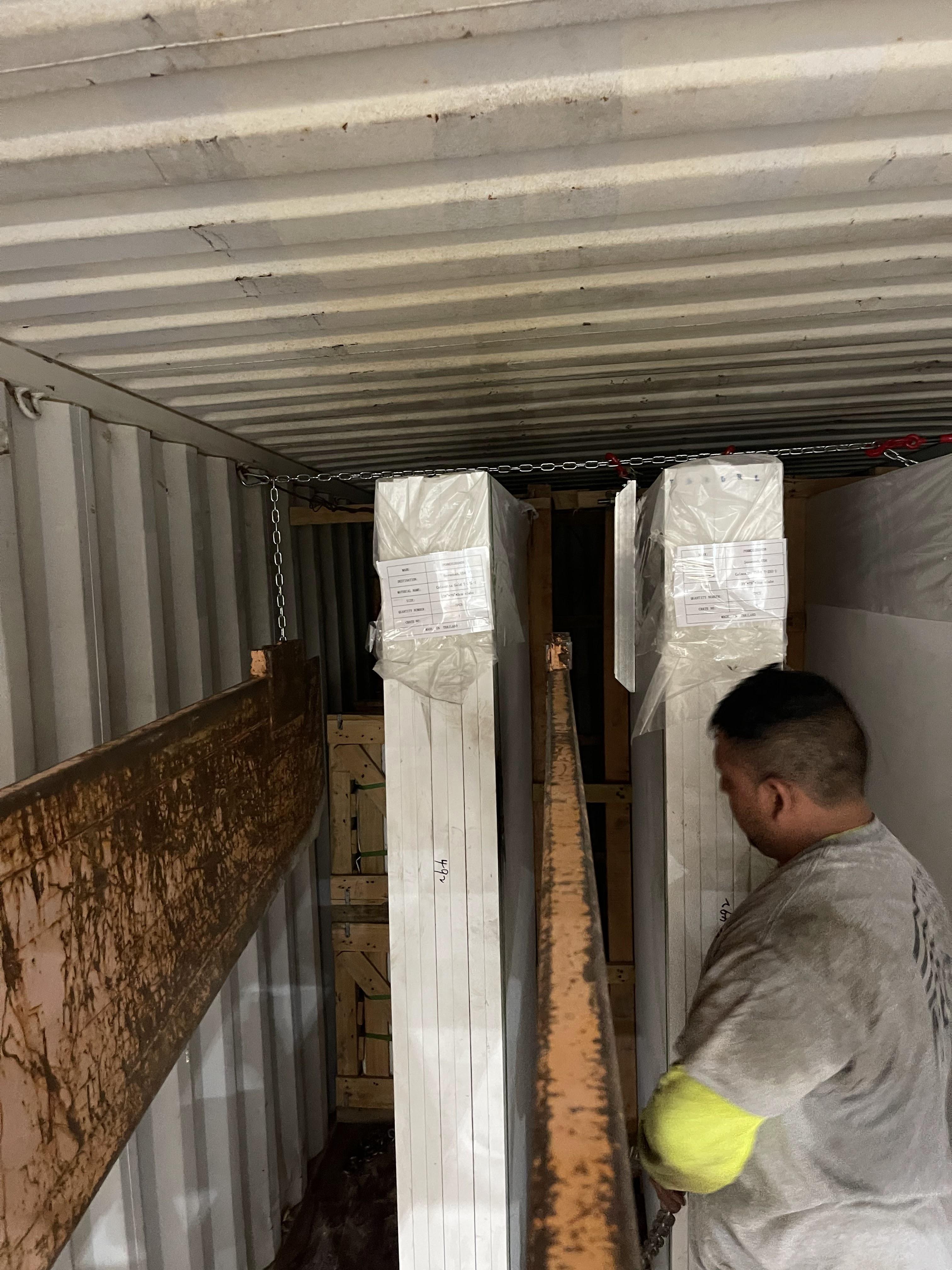
Instead of relying on temporary wood bracing or overhead chain tension alone, this system introduces engineered mechanical stabilization before bracing is removed.

Stabilization first.
Brace removal second.
Control throughout unloading.

Heavy-duty structural components combined with RockLock™ adjustable compression arms create controlled contact points that prevent sudden forward or lateral bundle movement during brace removal and slab extraction.

Unlike improvised brace removal methods, this system is designed as a dedicated unloading safety mechanism:

- Overhead stabilization applied before wood brace release

- Adjustable mechanical compression for controlled bundle containment

- Designed to interrupt over-center rotation during unloading

- Compatible with standard container unloading procedures

- Engineered to reduce uncontrolled tip events at the point of release

This is not a shipping brace.

It is a purpose-built unloading stabilization system engineered to control structural uncertainty inside containers.

🔩 Key Container Stabilization Advantages

✅ Active restraint before brace removal
✅ Mechanical compression instead of passive wood blocking
✅ Controlled bundle stabilization during slab extraction
✅ Reduced sudden tip risk during container unloading
✅ Designed specifically for container bundle environments

How the Container Bundle-Stabilization Mechanism with RockLock™

Controls Bundle Stability
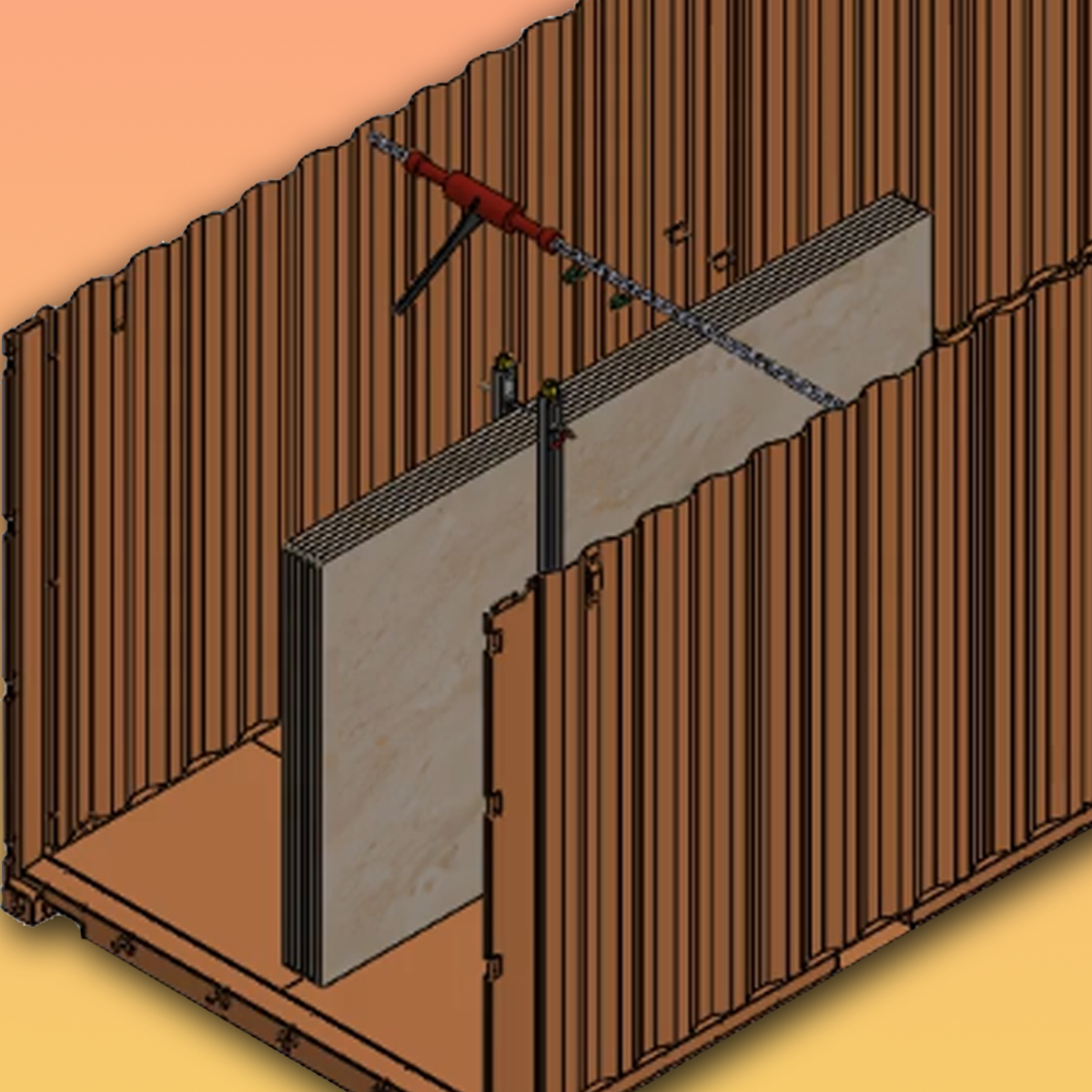
Step 1

Position the Overhead Support Assembly
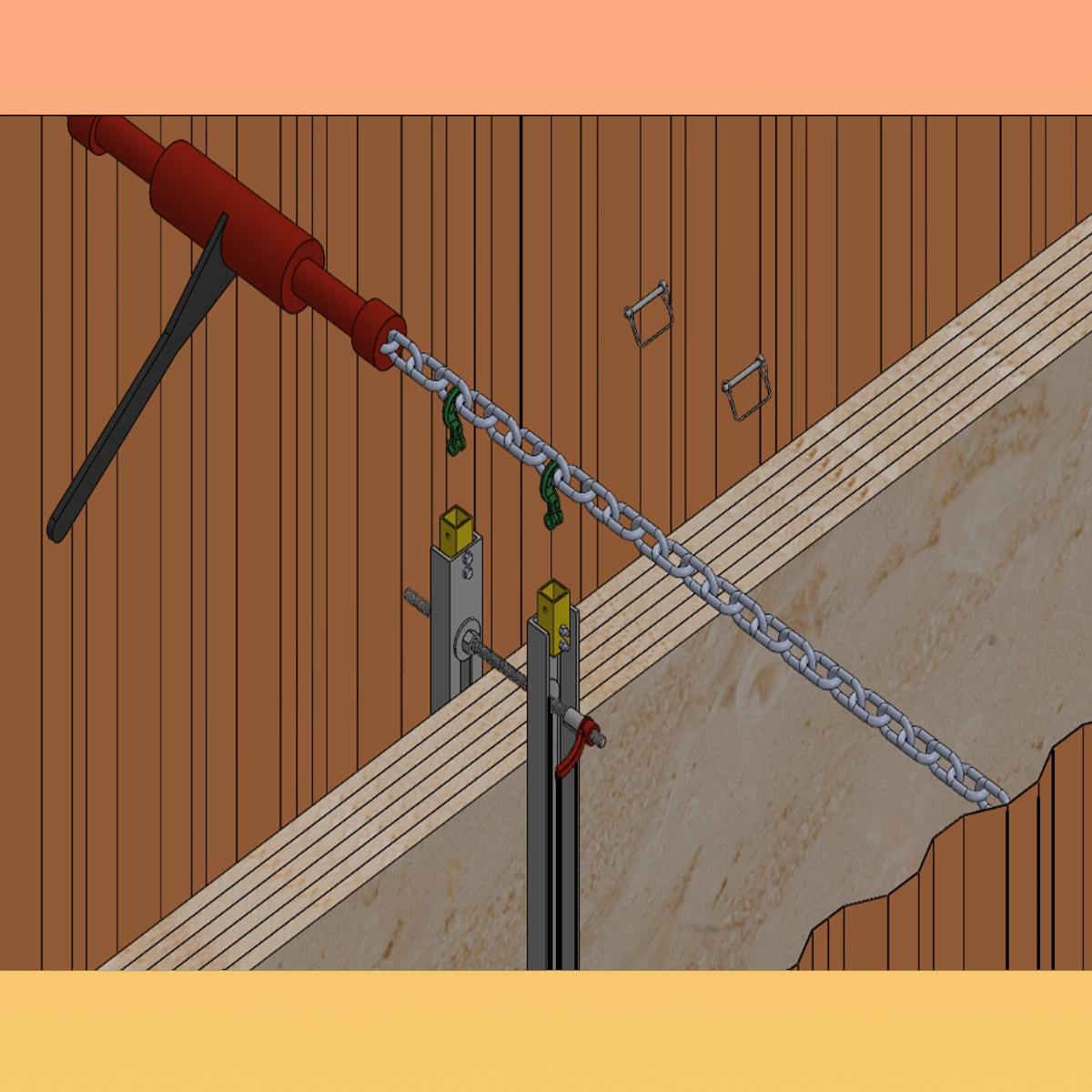
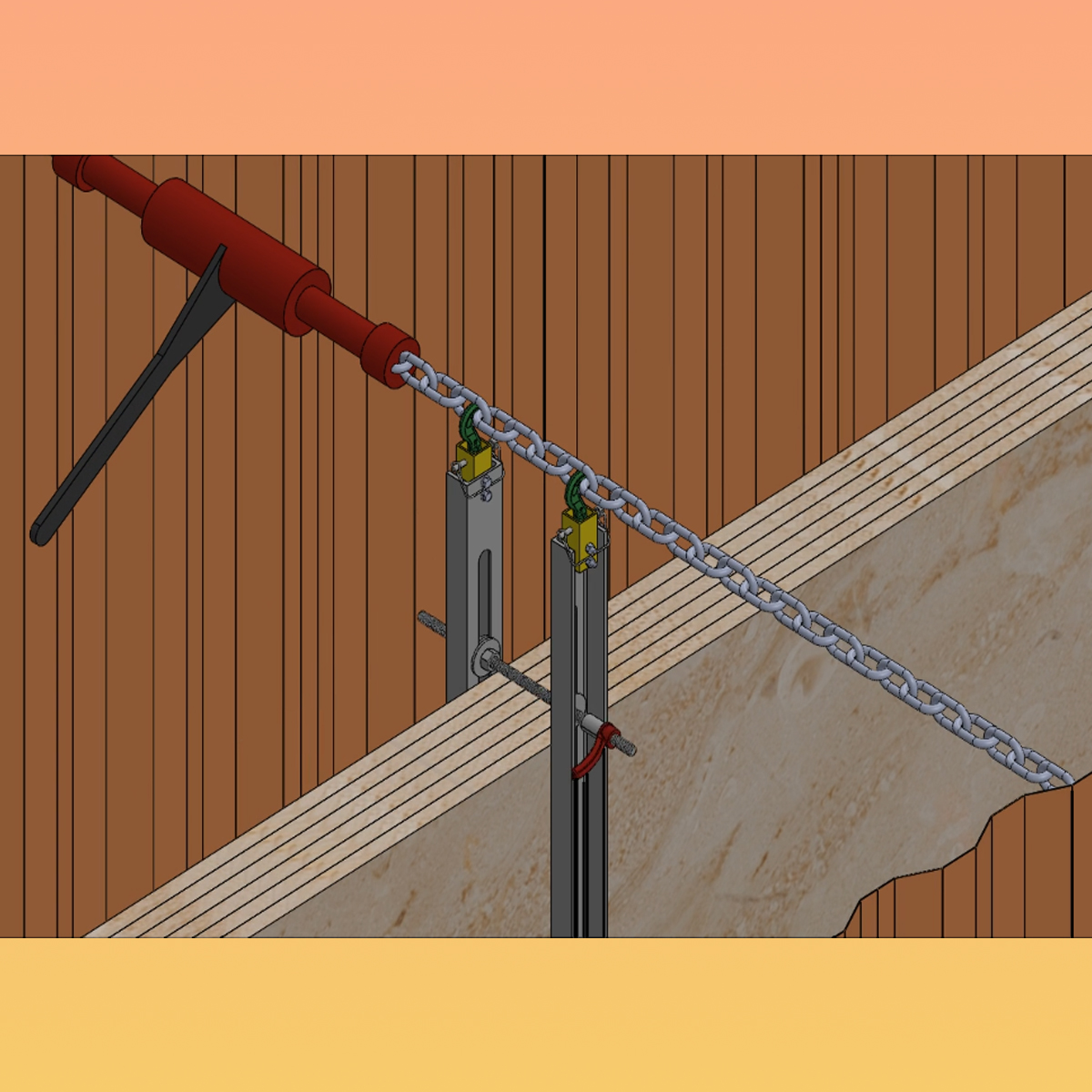
Mount the telescoping steel tubes in the container at the specified bay, aligning them over the stone bundle lane.


Adjust tube length to match container width and pin the assembly into place so it bears against the side walls.

This creates a rigid overhead support frame directly above the bundle stack.
Movement controlled at the source.


Step 2

Create the Engineered Compression Zone
Attach the tensioned overhead chain or lifting line to the support assembly connection points.

Lower the chain until the compression pad contacts the top of the targeted bundle row.

The contact area becomes an engineered compression zone that resists forward rotation as the bundle is released.


Step 3

Engage the RockLock™ Compression System
Lock the RockLock™ mechanism to hold the chain at the required compression setting.

The system applies controlled downward force to the bundle stack, stabilizing it while:

- Front bundles are separated or pulled forward

- Straps, chocks, or temporary wood blocking are removed

- Forklifts or cranes reposition bundles inside the container mouth


Compression keeps the center of mass behind the support line, interrupting the over-center tip sequence.


Step 4

Control Instability During Unloading

As each bundle is removed, the mechanism maintains compression on the remaining stack.

If the floor is uneven, blocking shifts, or a bundle snags during extraction, the overhead system absorbs the movement instead of letting the stack pitch toward the opening.

Instability is contained at the top of the load before it can become a full-height cascade.


Step 5

Release and Reposition Safely
Once the active bundle is cleared and the remaining stack is confirmed stable, the operator releases RockLock™ compression in a controlled manner.

The assembly can then be slid or re-pinned to the next bay and reset for the following bundle row, without cutting new wood or re-building temporary supports each time.


Replace disposable wood blocking and guesswork with engineered container-bundle stabilization using RockLock™ mechanical compression.

Engineering Specifications & Performance Data

Model: SSH CBL-10
Application: Container Bundle Stabilization & Controlled Unloading

🔩 Structural & Mechanical Features

  • Heavy-duty structural steel overhead stabilization assembly

  • Integrated RockLock™ mechanical compression restraint system

  • Telescoping container-width support tubes

  • Reinforced compression contact plate for bundle engagement

  • Mechanical quick-lock compression hardware

  • Engineered load path designed for over-center interruption

  • Designed specifically for overseas container bundle unloading

📐 Technical Specifications

  • Primary Restraint Type: Mechanical compression (RockLock™)

  • Construction: Heavy-duty structural steel

  • Finish: Powder-coated corrosion-resistant steel

  • Mounting: Telescoping container wall engagement system

  • Designed For: Dynamic unloading instability (brace removal, load shift, compression release)

  • Deployment: Field mechanical installation – no welding required

  • Compatibility: Standard 20 ft and 40 ft shipping containers

Operational Risk & Container Unloading Liability Exposure

The Hidden Liability of Temporary Container Bracing

Traditional container bundle stabilization depends on wood blocking and temporary compression.

Wood shifts.
Wood compresses.
Wood degrades during ocean transit.

When bracing is cut, the load condition is unknown.

If vibration, humidity, or internal shifting has altered bundle alignment, instability is already present before unloading begins.

Temporary bracing reacts only during shipment — not during brace removal.

That exposure creates risk in critical areas:

  • Sudden bundle shift when wood supports are removed

  • Over-center forward rotation at container openin

  • Worker exposure inside confined collapse zones

  • OSHA citations tied to uncontrolled unloading procedures

  • Product loss during container discharge

  • Insurance disputes following tip-related injury events

Temporary bracing relies on material condition.
Material condition changes in transit.
Every variable increases structural uncertainty.

The Engineered Stabilization Difference

The Container Bundle-Stabilization Mechanism with RockLock™ replaces temporary brace dependence with controlled mechanical compression applied before unloading begins.

Instead of reacting to bundle movement, it introduces fixed structural restraint at the top of the stack during brace removal.

This changes the liability equation.

Measurable Organizational Benefits

  • Stabilizes bundles before wood brace removal

  • Reduces sudden forward tip risk inside containers

  • Minimizes worker exposure during high-risk release moments

  • Improves OSHA defensibility with engineered procedure

  • Demonstrates proactive risk mitigation to insurers

  • Standardizes container unloading safety across facilities

Mechanical compression does not depend on wood integrity.
It depends on structure.

That distinction matters when gravity takes control inside a confined steel container.

"With the RockLock™, we finally feel confident sending out 2-man teams with a single truck.

No more balancing acts."
— Field Supervisor, Fabrication Partner

Take Control of Container Unloading Stability Today

Wood shifts.
Humidity changes.
Gravity doesn’t.

The Container Bundle-Stabilization Mechanism with RockLock™ replaces temporary brace dependence with engineered mechanical compression designed specifically for controlled container unloading.

Stabilize before you cut.
Control before you release.

Protect your crew.
Reduce unloading uncertainty.

Standardize engineered stabilization across every container arrival.

Temporary bracing invites unpredictability.
Mechanical compression delivers control.

Unloading safety isn’t a procedure.
It’s a structural decision.

Container Bundle-Stabilization Mechanism FAQS

What problem does the Container Bundle-Stabilization Mechanism solve?

It stabilizes slab bundles inside shipping containers during unloading.

When overseas support blocks are removed, slab bundles can shift or tip forward unexpectedly. This system provides engineered structural control before instability develops — reducing collapse risk during container unloading.

Is this a strap replacement system?

No.

This is not a strapless truck transport system. It is a container unloading stabilization mechanism.

Straps and chains may still be used as secondary measures. RockLock™ provides structural mechanical compression to prevent forward bundle rotation when temporary overseas blocking is removed.

When is this system used?

It is used during:

- Shipping container unloading

- Removal of temporary wood blocking

- Overhead crane extraction of slab bundles

- Initial forward movement after container doors are opened

This is the highest-risk phase of container slab handling.

How does RockLock™ stabilize slab bundles?

The system applies fixed mechanical compression at engineered contact points against the slab bundle.

Instead of relying on strap tension or friction, it creates controlled structural resistance against forward rotation — reducing unpredictable movement when gravity shifts.

Mechanical compression does not depend on stretch.

It depends on structure.

Does it require permanent container modification?

No.

The system is field-deployable and mechanically assembled. It is designed for professional installation without permanent structural alteration to shipping containers.

What makes container unloading so dangerous?

During overseas transit:

- Wood blocks absorb moisture

- Blocking compresses

- Containers flex

- Vibration shifts load centers

When blocking is removed, the slab bundle can already be unstable.

If forward rotation begins before restraint engages, collapse can occur quickly.

This mechanism addresses that exact transition moment.

Is this designed for OSHA and insurance defensibility?

Yes.

The system:

- Establishes engineered structural control

- Reduces dependence on temporary blocking

- Demonstrates proactive risk mitigation

- Strengthens unloading procedures

- Supports documented safety protocols

It is built to reduce operational liability exposure.

Can this system be used with overhead cranes?

Yes.

It is specifically designed to stabilize bundles before and during overhead crane extraction — reducing sudden forward shift when lifting begins.

Does it eliminate the need for proper training?

No.

It enhances safety but does not replace trained operators, proper procedures, or standard safety compliance practices.

It is a structural safeguard — not a substitute for professional handling.

Who should consider this system?

- Stone importers

- Slab warehouses

- Fabrication facilities

- Operations managers

- Safety directors

- Companies unloading containers regularly

If slab bundles enter your facility by container, this mechanism directly addresses your highest unloading risk.