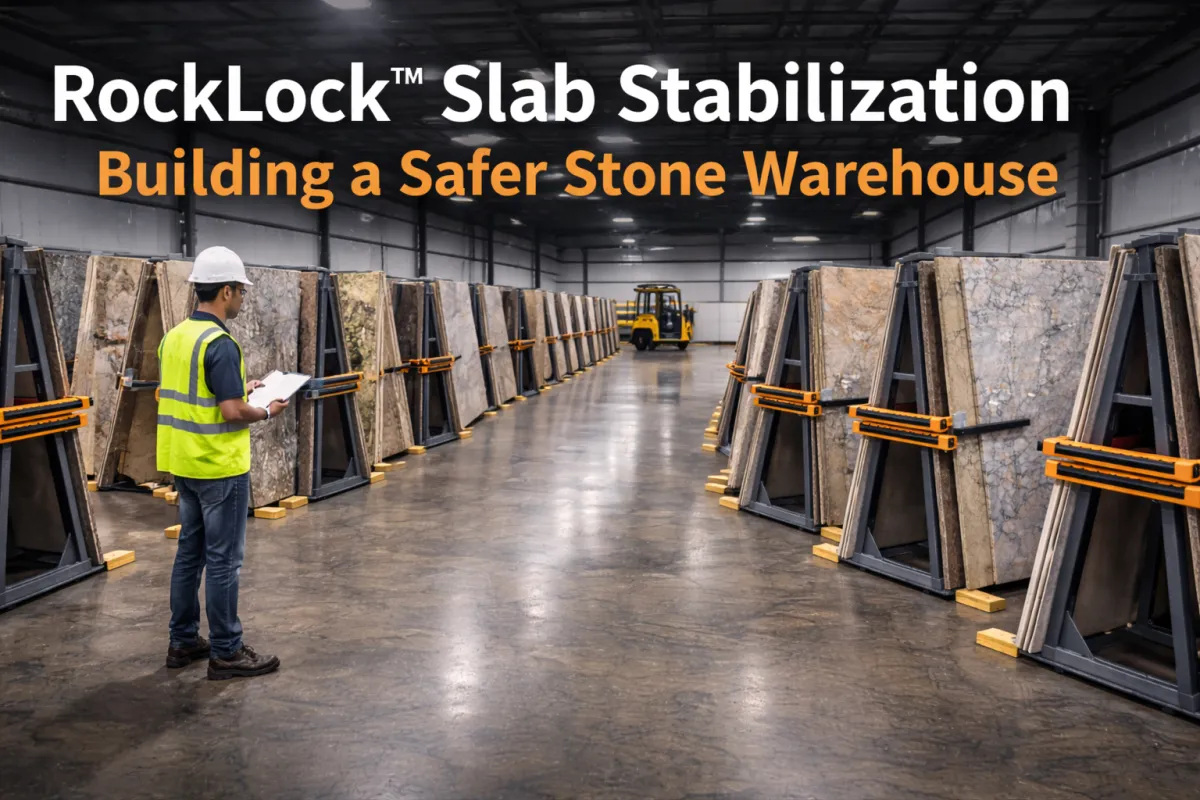
RockLock™ Slab Stabilization: Building a Safer Stone Warehouse
The Hidden Risk in Slab Storage: Why Warehouse Safety Starts Before the First Forklift Move
Most stone industry professionals think about slab safety in terms of transport and delivery — strapping loads down for the road, positioning slabs carefully during installation. Those risks are real, and they deserve attention. But a significant number of slab-related injuries never make it that far. They happen inside the warehouse, during the quiet, routine moments that nobody thinks twice about.
Forklift repositioning. Bundle staging. A worker reaching into an A-frame to check a slab. These are everyday operations at fabrication shops and distribution yards across the country — and they represent some of the most consistent, underappreciated hazard points in the stone industry.
Understanding why warehouse slab storage creates risk — and what it actually takes to control that risk — is the first step toward building a safer operation.
Why Slab Accidents Often Begin in the Warehouse
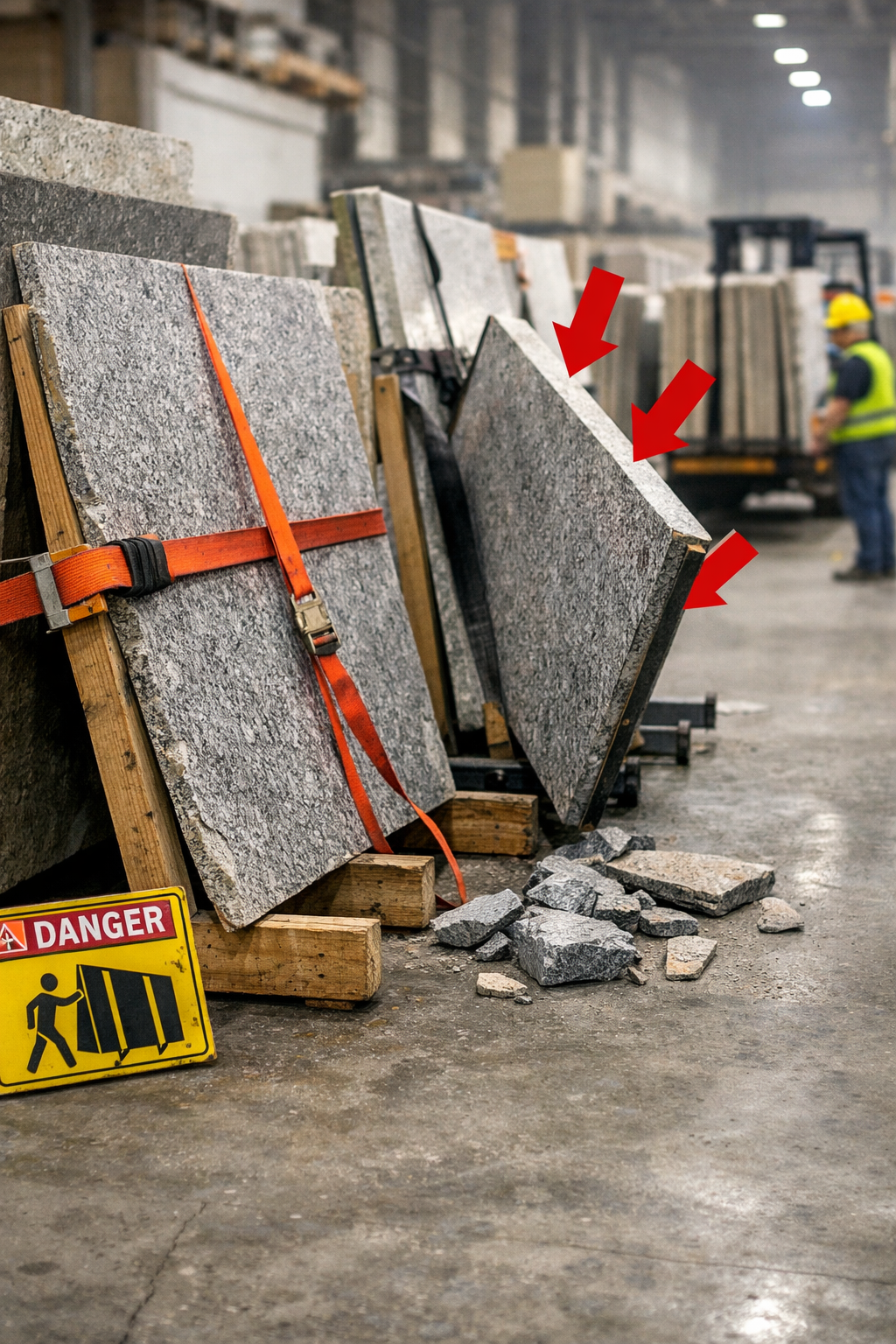
Stone slabs present a handling challenge that most other building materials don't: they're stored vertically. A full granite or quartzite slab can weigh anywhere from 400 to over 1,000 pounds, and it stands edge-down on an A-frame at a height of six feet or more. That vertical orientation is necessary for space efficiency and structural reasons, but it means the slab's center of gravity is elevated — and any lateral movement can initiate a tip.
In the warehouse environment, lateral forces are constantly present, even when nothing dramatic is happening:
Forklift movement near A-frame rows creates floor vibration that transmits directly to slabs through the frame
Bundle repositioning shifts the load distribution across the frame, sometimes unevenly
Slab retrieval — pulling one slab from a packed A-frame — changes the load balance on the remaining slabs
Vibration from nearby equipment (saws, CNC machines, overhead cranes) introduces continuous low-level movement
Straps that have loosened over time may appear serviceable but no longer provide meaningful restraint
None of these individually sounds alarming. But when a slab begins to tip, it does so quickly and without warning. The physics are unforgiving: once a slab's center of gravity passes its base of support, gravity takes over. At that point, the outcome is determined by the engineering of the system holding the slab — not by the reaction time of whoever is standing nearby.
Why Traditional A-Frame Storage Was Never Designed as a Safety System
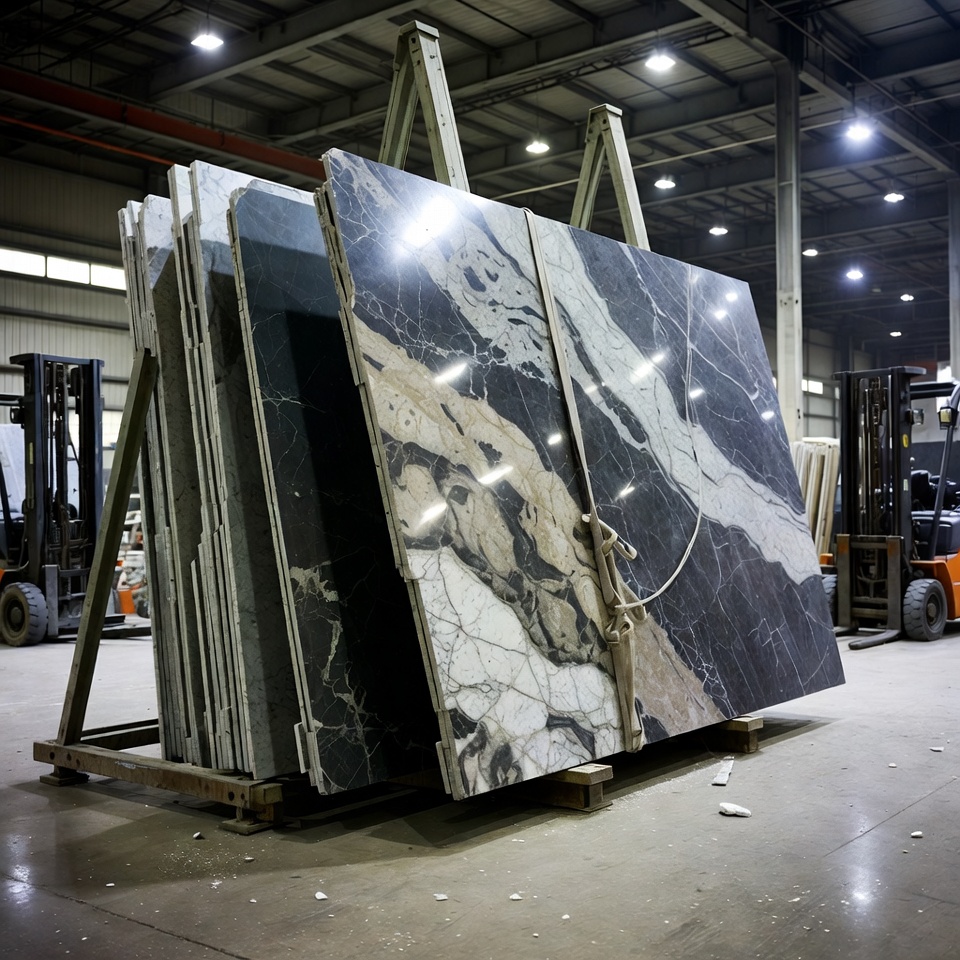
This is a distinction worth stating plainly: A-frames are structural supports, not safety devices.
A standard warehouse A-frame is designed to hold slabs upright and organize them for efficient access. It does that job well. What it was not engineered to do is prevent tip-over under dynamic loading conditions, resist lateral forces from forklift activity, or maintain slab stability when the load distribution changes. These are safety functions, and they require safety engineering.
The common reliance on straps to fill this gap is understandable, but straps have meaningful limitations in a warehouse context:
Straps are designed to hold a bundle together, not to prevent the entire A-frame load from tipping
Strap tension degrades over time from repeated loading cycles, UV exposure, and abrasion against stone edges
Vibration from nearby machinery can cause straps to relax gradually, reducing their effective tension without any visible indication
When workers need to access individual slabs, straps are often loosened or removed — creating an unrestrained window during one of the highest-risk moments
The result is that many warehouses operate with slabs that appear secured but are, in practice, held in position by friction and favorable geometry. That's adequate until it isn't — and when conditions shift, workers standing near the A-frame have no meaningful margin to respond.
The Geometry of a Tip
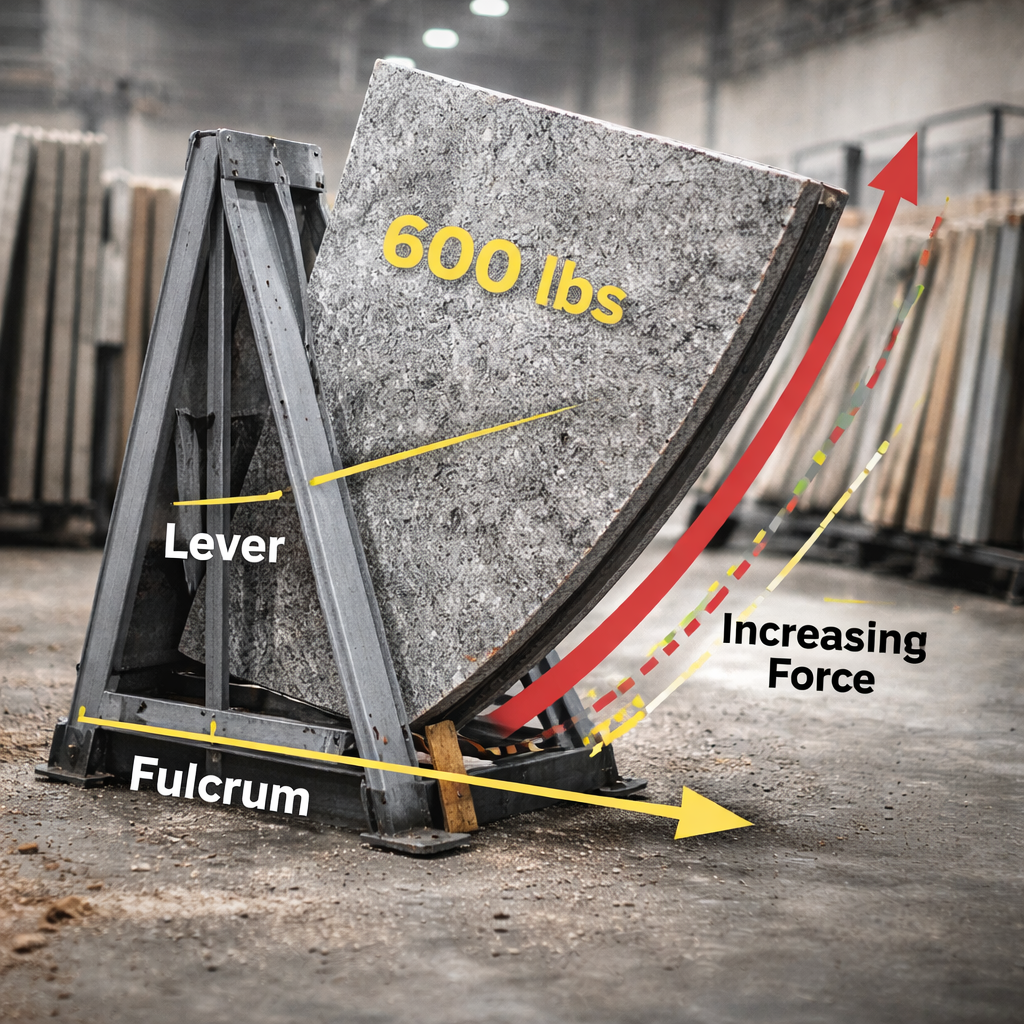
Consider what happens when a 600-pound slab begins to lean laterally on a standard A-frame. The slab acts as a lever, with the A-frame base serving as the fulcrum. As the angle of lean increases, the effective moment arm lengthens, and the rotational force required to continue the tip decreases. This means that a slab that starts to fall accelerates through the motion — it doesn't slow down and give a worker time to intervene. It falls faster as it goes.
This is why the industry's conventional approach — "be careful and pay attention" — is insufficient as a primary safety strategy for slab storage. Human reaction time simply cannot match the physics of a falling slab.
OSHA's Expectations for Stored Material Stability
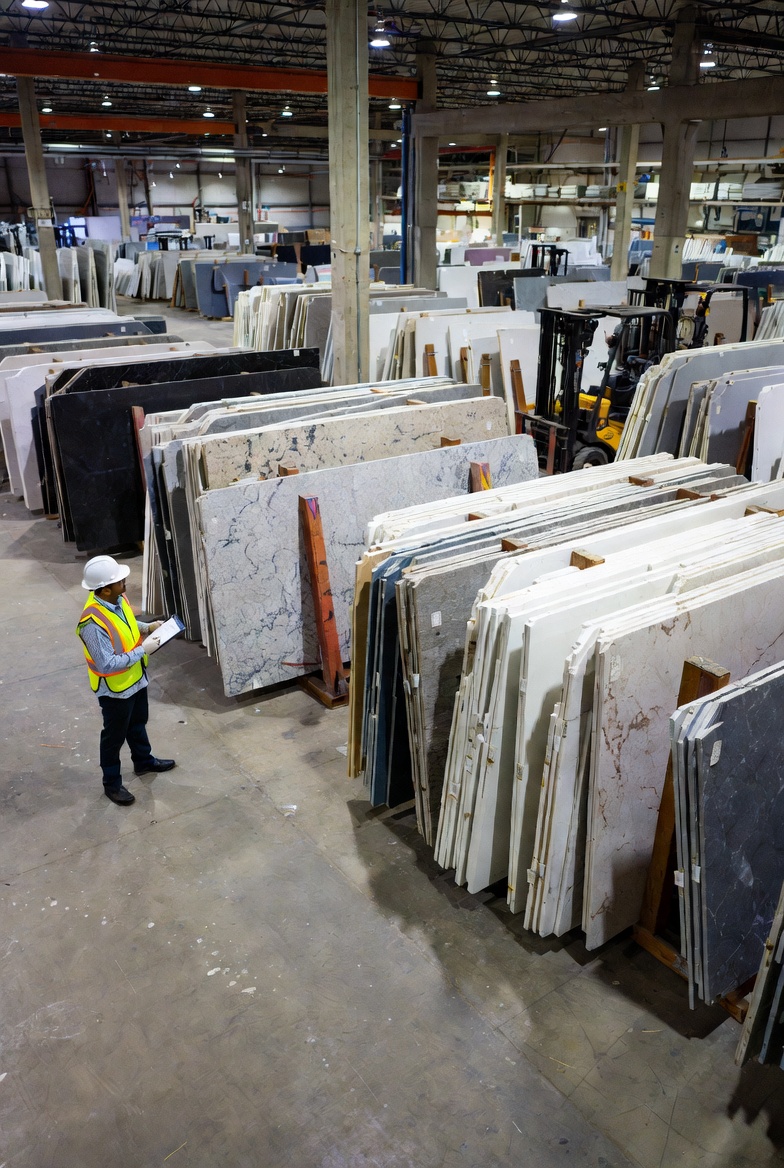
OSHA's general industry standards address material storage directly. Under 29 CFR 1910.176, OSHA requires that stored materials be stacked, blocked, interlocked, and limited in height to prevent them from collapsing, sliding, or tipping. The standard places the responsibility for maintaining stable storage conditions squarely on the employer.
In practical terms, this means that if slabs are stored on A-frames in your facility and those A-frames lack mechanical systems to prevent tip-over, you carry the liability exposure that comes with that condition. OSHA's framework is built on the hierarchy of controls — and within that hierarchy, engineering controls (physical systems that prevent hazardous movement) are ranked above administrative controls (procedural rules and warnings) and personal protective equipment.
Relying on workers to stay alert and move quickly is an administrative control. It has value, but it cannot substitute for a system that physically prevents the hazard from occurring.
This is not a legal opinion — it's a description of how OSHA's framework applies to a well-documented material handling risk. Any operation handling stone slabs at scale should consult with their EHS team or safety compliance advisor to assess their specific exposure.
Engineering Controls vs. Human Reaction: Understanding the Difference
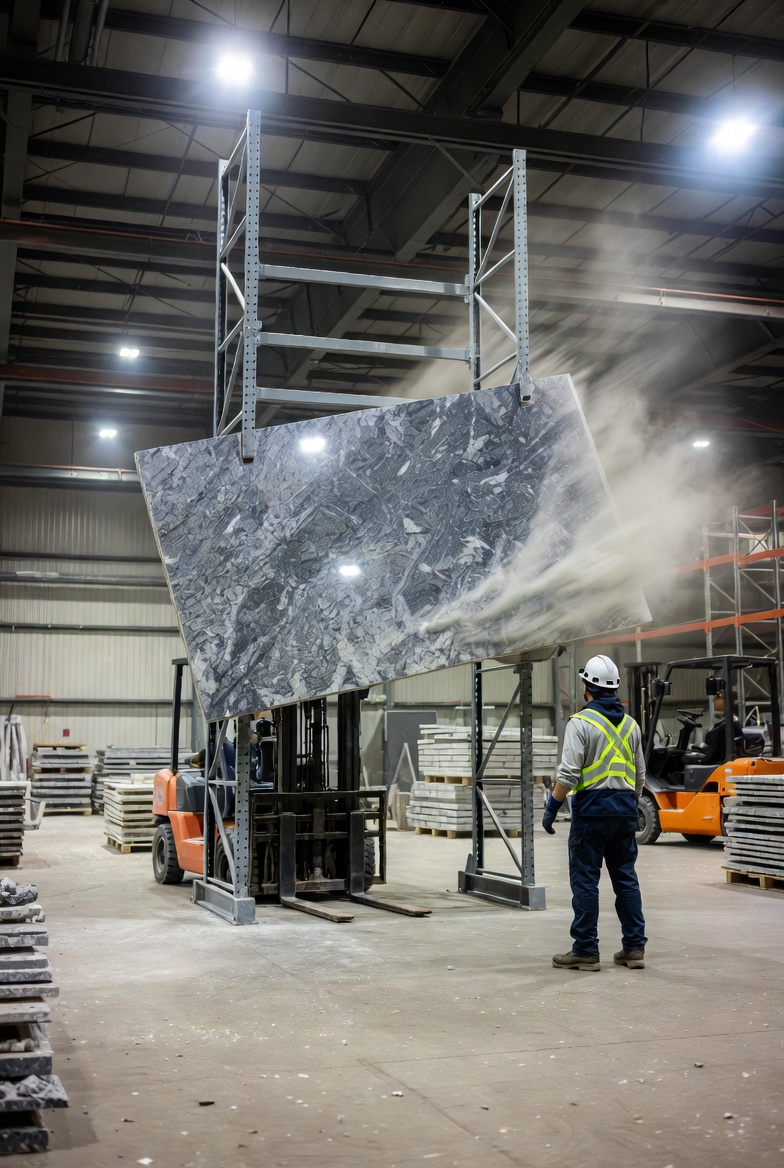
The hierarchy of hazard controls is a foundational concept in occupational safety. At the top of the hierarchy are elimination and substitution — removing the hazard entirely or replacing it with a less dangerous alternative. Below that are engineering controls: physical modifications to the work environment or equipment that prevent the hazard from causing injury, regardless of worker behavior.
Engineering controls are preferred over behavioral controls for a straightforward reason: they work even when conditions are imperfect. A worker might be distracted, fatigued, unfamiliar with the area, or simply not positioned to react in time. An engineering control doesn't have those variables.
For slab storage safety, the relevant engineering control question is: does this system physically prevent a slab from tipping, or does it depend on someone noticing and responding to a developing tip?
Most warehouse A-frames, as currently configured in the stone industry, fall into the second category. Straps create a degree of resistance, but they don't provide a mechanical barrier against lateral movement. A true engineering control for slab tipping would need to:
Apply a restraining force directly to the slab at a point that resists lateral movement
Maintain that restraint independent of strap tension or worker attention
Remain effective during the dynamic conditions of normal warehouse operations
This is the functional gap that mechanical slab safety systems are designed to address.
How the RockLock™ System Addresses Slab Stability in Warehouse Conditions
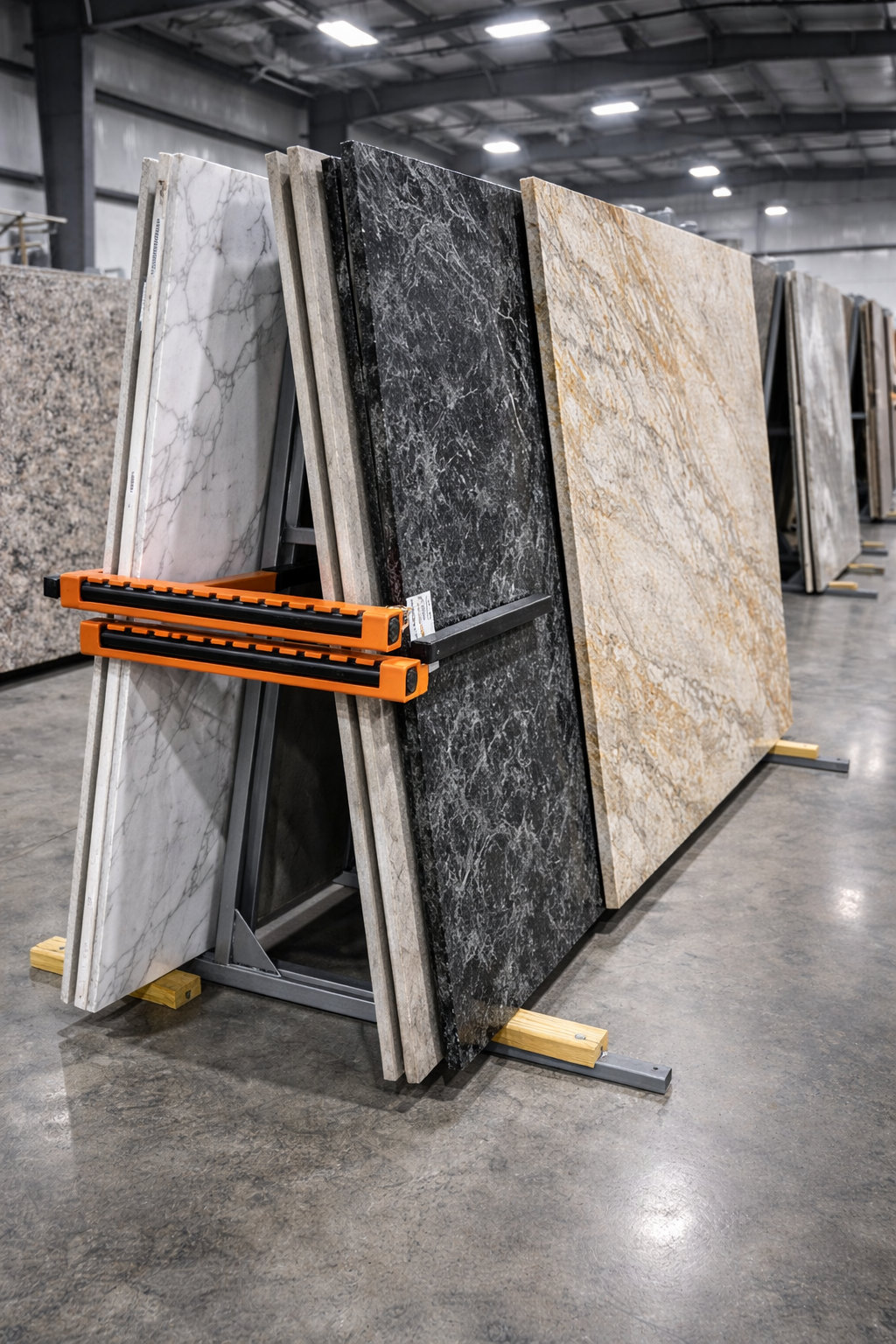
The RockLock™ Warehouse Slab Safety System from Safe Stone Handling was developed to provide the kind of mechanical restraint that standard A-frame storage lacks.
The system uses the patented RockLock™ Adjustable Arm System to create a physical barrier that holds slabs against lateral movement. Rather than relying on strap tension — which is variable, degrades over time, and provides no resistance once a slab begins to tip — the RockLock™ arms engage directly with the slab stack and maintain controlled positioning through mechanical contact.
The key distinction is this: the system provides mechanical restraint, not strap tension. When a slab experiences a lateral force — from a nearby forklift, from load redistribution as a slab is removed, or from vibration — the RockLock™ arms resist that movement directly. The restraint is present and consistent, not dependent on how well straps were tensioned that morning or how long ago they were last checked.
For warehouse applications, the SSH-KD 20 configuration holds up to 20 slabs and attaches to standard A-frames with an assembly time of 10 to 20 minutes. This means existing warehouse infrastructure doesn't need to be replaced — the system is designed to upgrade the safety performance of the A-frames already in use.
It's worth noting that this system still uses conventional straps or approved tie-downs for transport applications — the fully strapless functionality of the RockLock™ system is specific to the SSH TAF-SL 30 Truck A-Frame. In warehouse storage and staging contexts, the RockLock™ arms work alongside standard storage practices to provide the mechanical barrier that straps alone cannot offer.
The result is a storage configuration where the safety of the slabs is not contingent on perfect conditions, fresh strap tension, or workers being in exactly the right position at exactly the right moment.
Building a Safer Warehouse: What This Means in Practice
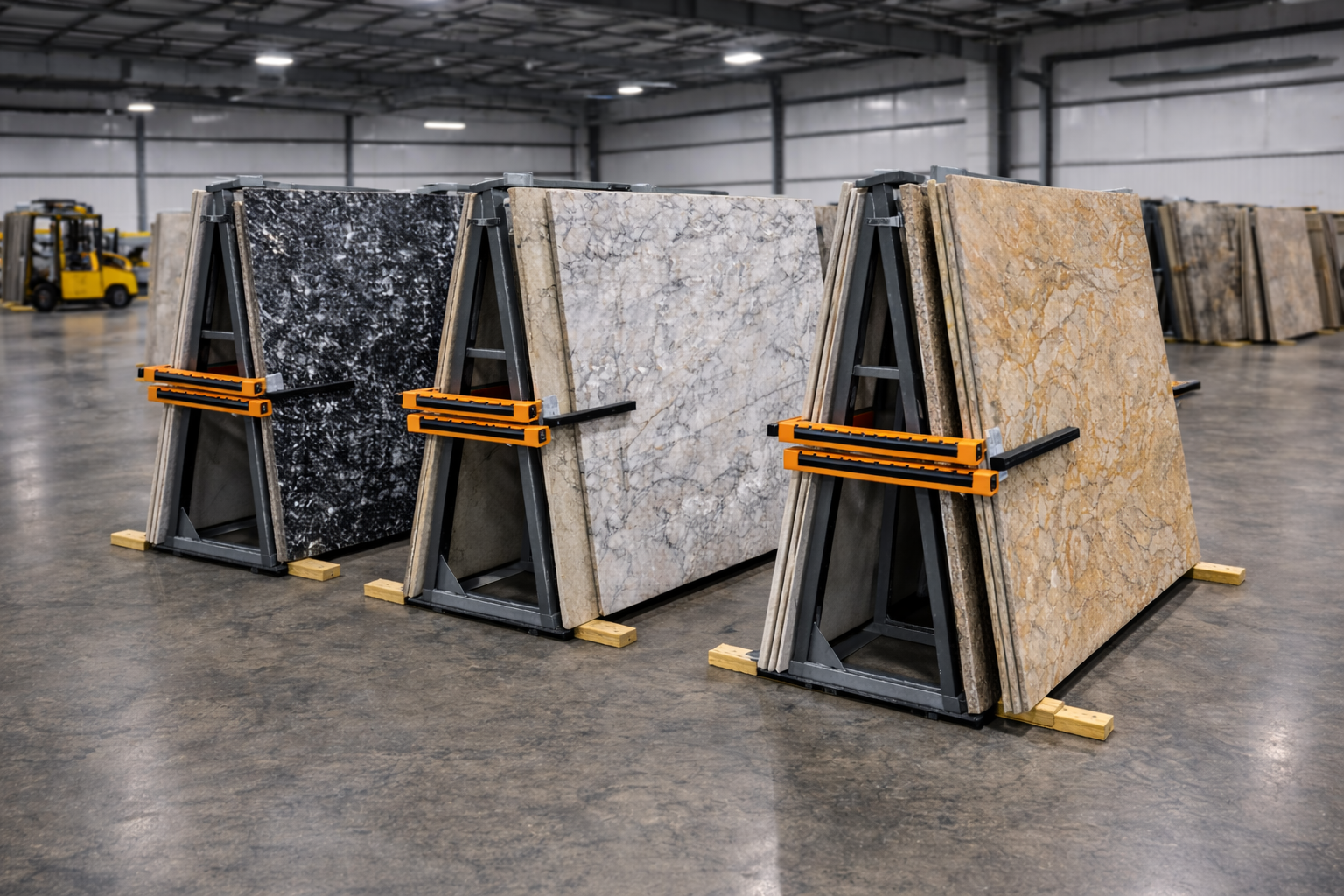
Implementing better slab storage safety doesn't require a complete overhaul of warehouse operations. In most cases, it requires a clear-eyed assessment of where the actual risk points are — and whether current systems address those risk points with engineering controls or with behavioral ones.
Some questions worth applying to any warehouse slab storage setup:
If a slab bundle shifted right now, what would stop it? Is the answer a mechanical system, or is the answer "someone would notice and respond"?
Are straps checked before every shift, or are they assumed to be adequate from the last time they were adjusted?
Are workers routinely positioned in or adjacent to A-frame rows during forklift activity?
When a slab is retrieved, does the remaining load have independent mechanical restraint, or is it held in position by the adjacent slabs?
None of these questions have trick answers. They're practical checkpoints for evaluating whether a warehouse's slab storage system is functioning as an engineered safety system or as an organizational storage solution with safety assumed.
Conclusion: Warehouse Safety Requires More Than Good Intentions
The stone industry does physically demanding, skilled work. Most of the people in it take safety seriously. The problem with relying on caution and attention as the primary slab stability strategy isn't that workers aren't careful — it's that careful isn't enough when the physics are working against you.
A 600-pound granite slab that crosses its tipping threshold is falling regardless of how attentive anyone nearby happens to be. The margin between a close call and a serious injury, in those situations, is often just a matter of geometry and timing. Those are not factors that training and awareness can reliably control.
True warehouse slab storage safety comes from systems that prevent tip-over before it starts — mechanical controls that hold slabs in stable positions during the dynamic, variable conditions of real warehouse operations. That's the difference between storage infrastructure that keeps things organized and safety infrastructure that keeps people protected.
If your current A-frame setup depends primarily on strap tension and worker vigilance to maintain slab stability, it may be worth examining whether it meets the engineering control standard that OSHA's framework — and basic risk management — calls for.
To learn more about engineered slab safety systems for warehouse and staging applications, visit safestonehandling.com or contact the Safe Stone Handling team at 866-919-3225.
Safe Stone Handling designs and manufactures engineered slab safety systems for fabrication shops, distributors, and installers. The RockLock™ system is patented.
