Why Most Slab Injuries Happen at the Jobsite, Not the Warehouse
Safe Stone Handling — Installation & Jobsite Control
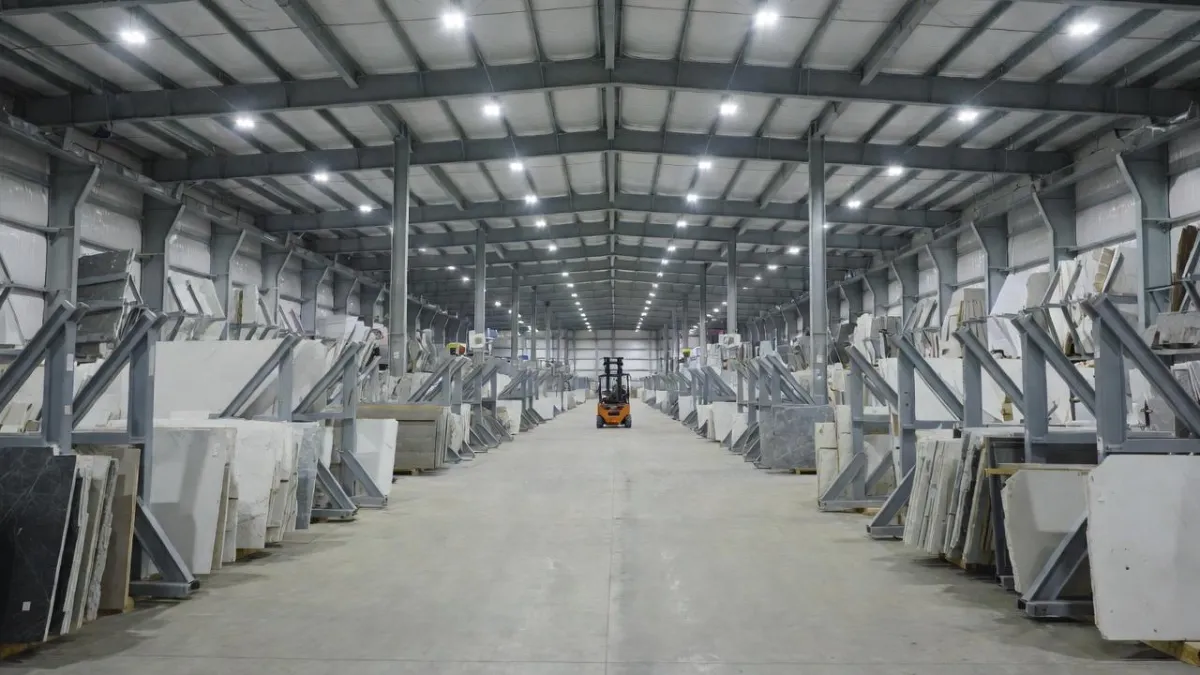
If you ask most people in the stone industry where slab injuries are most likely to occur, the instinctive answer is the warehouse. It makes sense on the surface: warehouses store hundreds of slabs vertically on A-frames, forklifts move heavy loads through tight aisles, and the sheer volume of material in motion seems like a recipe for incidents.
But the data tells a different story. The highest concentration of slab-handling injuries doesn't happen in controlled storage environments. It happens at the jobsite — during installation — where conditions are unpredictable, equipment is minimal, and the most physically demanding transitions take place.
Understanding why risk peaks at the point of installation is the first step toward reducing it. And the answer comes down to physics, fatigue, and the absence of mechanical restraint where it matters most.
Why Jobsite Transitions Create Peak Danger
In a warehouse, slabs sit vertically on engineered A-frames. They're stored in a stable orientation, managed by trained equipment operators, and handled according to repeatable procedures. The environment is controlled: flat floors, adequate space, consistent lighting, and purpose-built machinery.
The jobsite is none of those things.
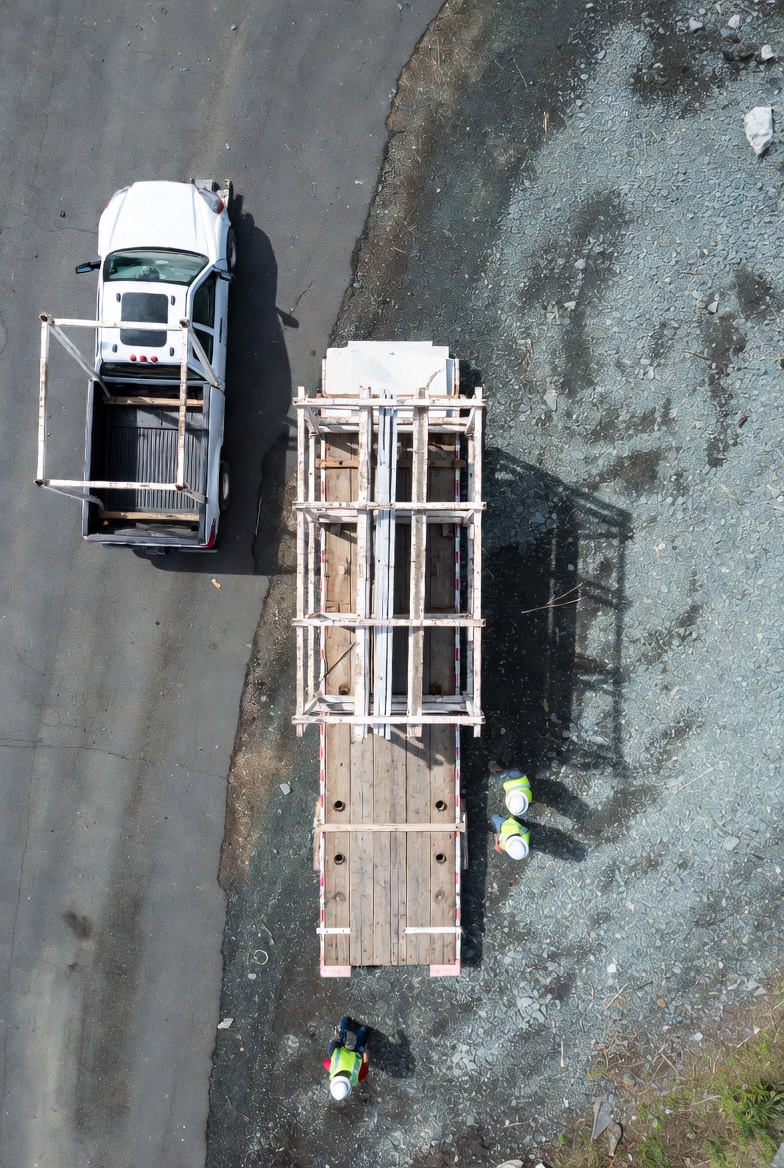
At the point of installation, stone slabs must be moved from a transport vehicle to a work area that was never designed for slab handling. Installers navigate unfinished floors, narrow doorways, stairs, uneven terrain, and cluttered work zones. The equipment available is typically limited to manual carry bars, suction lifters, and physical strength. And critically, the slab must undergo the single most hazardous transition in the entire handling chain: moving from vertical storage orientation to horizontal placement on a cabinet or vanity.
This is where countertop slab handling safety breaks down. Every variable that was controlled in the warehouse — stable footing, mechanical assistance, flat surfaces, ample clearance — is now uncertain or absent entirely. The installer becomes the primary restraint system, and human beings are not engineered for that role.
The Physics of Vertical-to-Horizontal Slab Movement
To understand why stone slab installation safety requires more than careful technique, you need to understand what happens physically when a slab changes orientation.
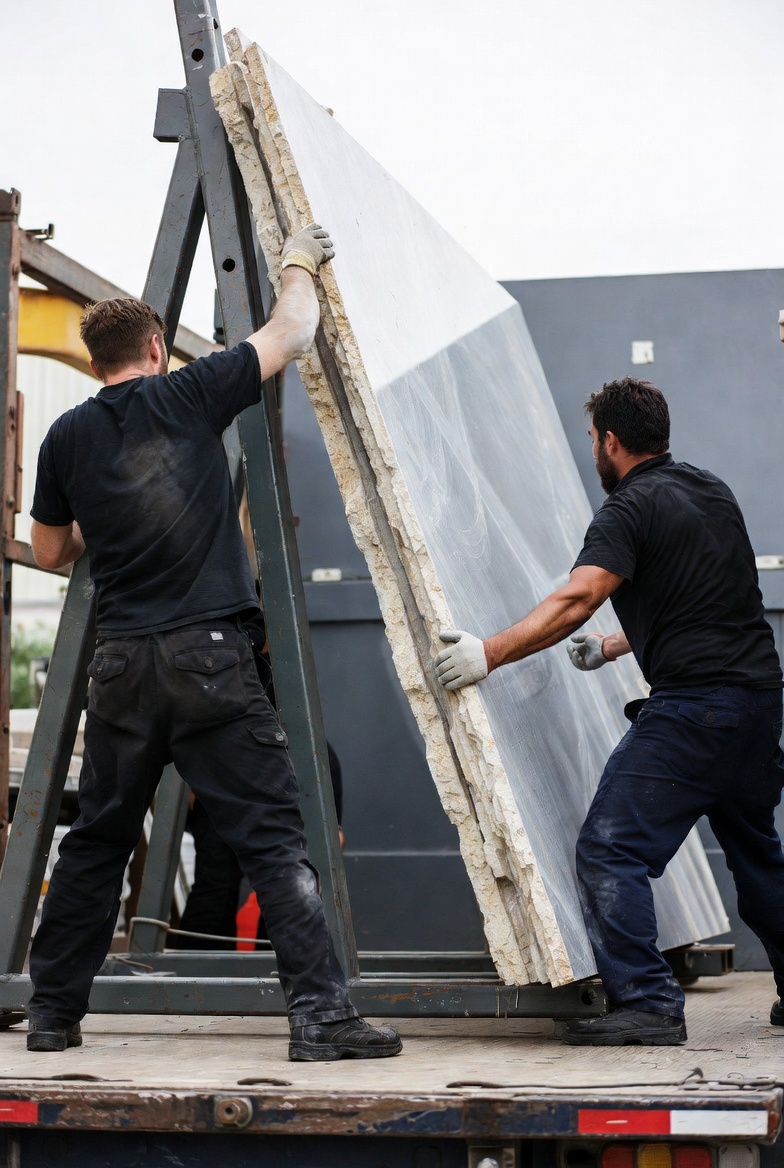
A typical countertop slab — granite, quartz, or porcelain — weighs between 200 and 700 pounds depending on material density, thickness, and dimensions. When stored vertically on an A-frame, the slab's center of gravity sits close to the support structure. The load is largely compressive, directed downward through the frame. Lateral forces are minimal as long as the slab stays in its stored position.
The moment that slab begins rotating from vertical toward horizontal, the physics change dramatically. As the slab tilts past roughly 45 degrees, its center of gravity shifts outward from the base of support. This creates an increasing moment arm — a lever effect — that generates lateral force the handlers must resist. The farther the slab tips from vertical, the greater the force required to control it. This isn't a linear increase. As the slab approaches horizontal, the full gravitational load transitions from a compressive vector into a cantilevered load that must be actively managed by the people holding it.
For a 400-pound slab being lowered to horizontal by two installers, each person may need to resist and control well over 100 pounds of dynamic lateral force during the transition — force that shifts direction as the slab moves. This is where large format slab handling becomes genuinely hazardous. A moment of lost grip, an uneven step, or a slight miscommunication between team members can turn a controlled descent into an uncontrolled fall.
The stone doesn't care about the installer's experience level. Physics applies the same forces regardless of who is holding the slab.
Fatigue, Strain, and Reaction Time
Slab lifting injury prevention isn't only about managing peak forces. It's also about understanding cumulative load and its effect on the people doing the work.
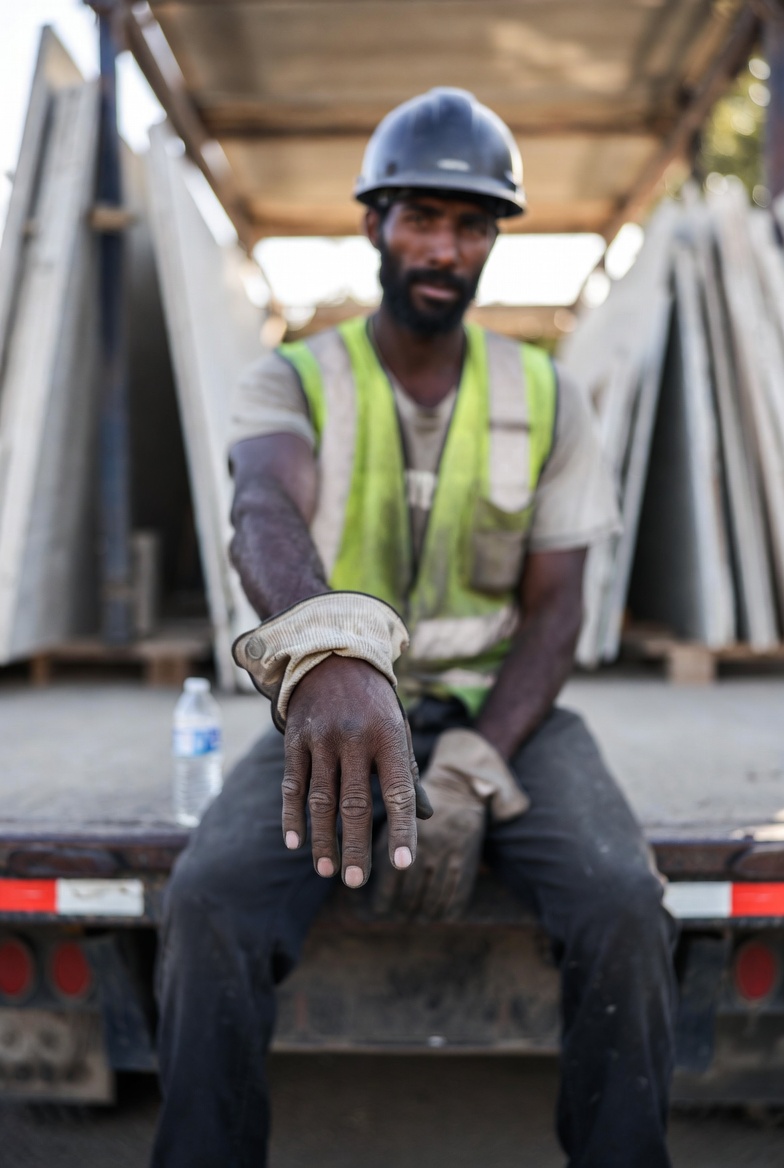
A typical installation crew handles multiple slabs per day across multiple jobsites. Each slab requires loading, transport, unloading, staging, and final placement. By the third or fourth installation, the installers carrying those slabs have already subjected their shoulders, backs, forearms, and grip to hours of sustained exertion.
Fatigued muscles respond more slowly. Grip strength declines. Reaction time — the interval between sensing a slab shifting and physically correcting it — increases measurably. Research in occupational biomechanics consistently shows that fatigued workers experience reduced proprioception, meaning their ability to sense the position and movement of a load degrades before they're consciously aware of it.
This is a compounding problem. The most dangerous moment in slab handling — the vertical-to-horizontal transition — typically comes at the end of the handling sequence, after the crew has already loaded, transported, and staged the material. By the time they're making the placement that demands the most precise control, their bodies are operating at reduced capacity.
Installer slab injuries cluster around this exact pattern: late in the day, during placement, when reaction times are longest and physical reserves are lowest.
The Hidden Cost of Panic Moments
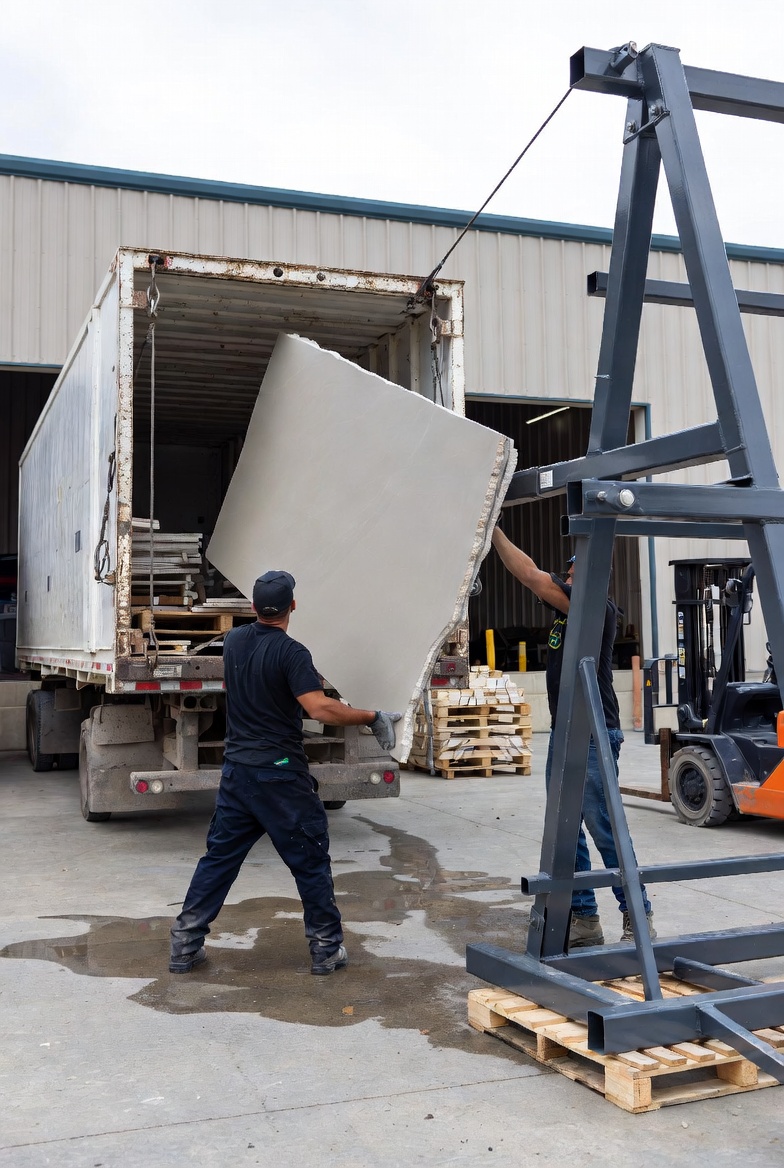
There's a phenomenon that anyone who has handled heavy slabs recognizes but rarely names: the panic moment. It occurs when a slab begins to move in an unintended direction and the handler's instinctive response overrides their trained technique.
During a controlled vertical-to-horizontal transition, the slab is supposed to follow a predictable arc. When something disrupts that arc — a foot slips, a suction cup releases, or the slab's weight shifts unexpectedly — the handler's immediate reaction is to try to stop the movement with raw force. This is a reflex, not a decision. And it's where a significant portion of installer injuries originate.
The physics are unforgiving. A 400-pound slab moving at even a moderate speed generates momentum that no individual can safely arrest with muscular effort alone. Attempting to do so results in back injuries, shoulder tears, crushed fingers, and broken feet. In the worst cases, a slab falling from a vertical or near-vertical position onto an installer can cause catastrophic injury.
These panic moments aren't caused by negligence. They're caused by the absence of a mechanical system to manage the forces involved. When the only thing between a moving slab and an injury is a person's grip strength and reaction time, the outcome depends entirely on human variables that degrade over the course of a workday.
How RockLock™ Installation Systems Change the Equation
This is the core problem that Safe Stone Handling's RockLock™ technology is designed to address — not by replacing skilled installers, but by giving them the mechanical advantage that manual handling cannot provide.
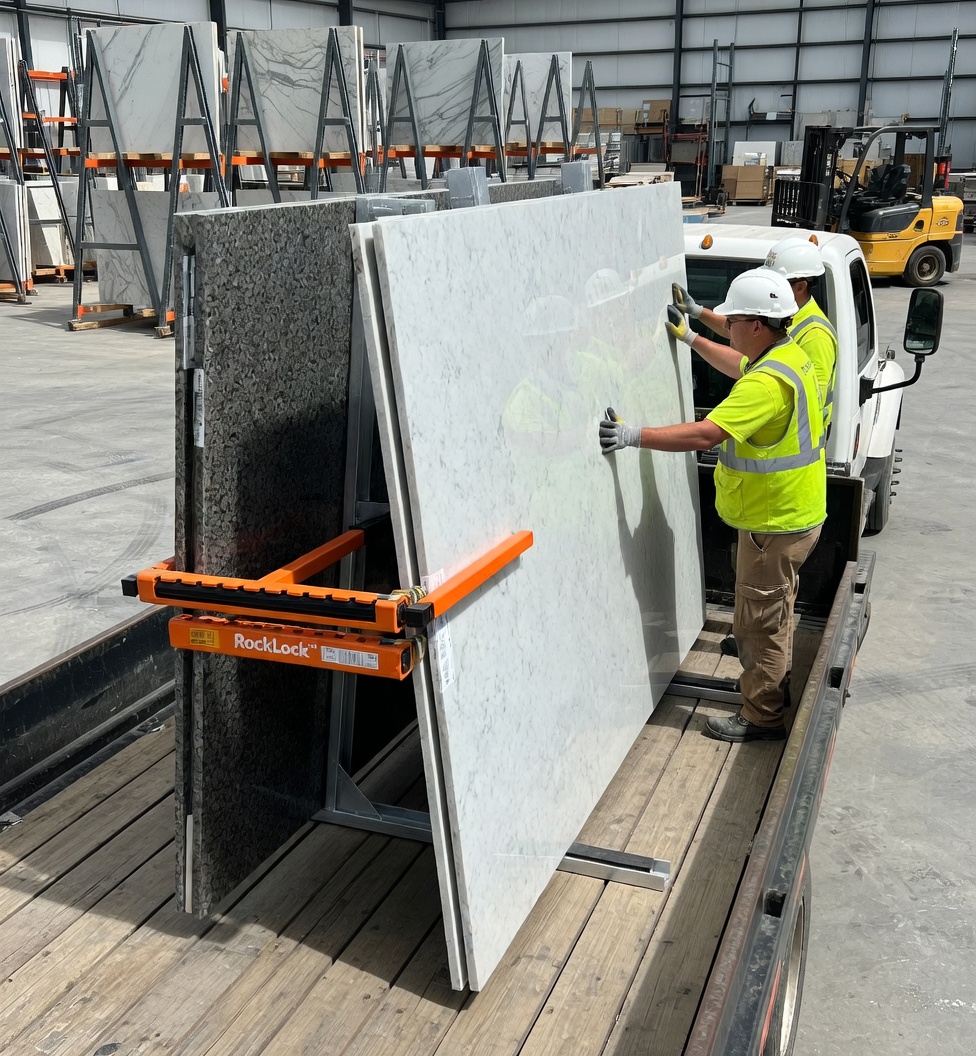
RockLock™ installation frames are engineered to create controlled movement paths during slab transitions. Rather than relying on strap tension or muscular force to keep a slab in position, the system uses patented adjustable arm locks that provide mechanical restraint at fixed points along the slab's surface.
The practical effect is straightforward: during a vertical-to-horizontal transition, the RockLock™ frame controls the arc of movement so the slab follows a predictable, constrained path. The installer guides the process; the mechanism manages the lateral forces. If a suction cup slips or a grip is lost, the slab doesn't enter free movement. It stays within the frame's restraint envelope.
This distinction — mechanical restraint rather than strap tension — matters because it removes the variables that cause panic moments. Straps stretch under load, loosen with vibration, and depend on correct tensioning by the operator. A mechanical lock either holds or it doesn't. There is no progressive degradation, no weather sensitivity, no judgment call about whether the restraint is tight enough. The physics are managed by the system, not by the person.
For jobsite slab safety systems, this represents a fundamental shift. Instead of training installers to be stronger, faster, and more alert — an approach that fights against the reality of physical fatigue — the RockLock™ system reduces the physical and cognitive demands on the crew by providing engineered stability throughout the handling process.
Practical Takeaways for Shop Owners and Installers
The pattern behind most installation injuries is consistent and predictable: uncontrolled slab movement during transitions, compounded by physical fatigue and the absence of mechanical restraint. Addressing this pattern doesn't require overhauling your entire operation. It requires targeting the specific moments where risk is highest.
First, recognize that your installation crew faces greater slab-handling risk than your warehouse team. The jobsite lacks every environmental advantage the warehouse provides — flat floors, purpose-built equipment, repeatable procedures, and adequate space. Your safety investment should reflect that reality.
Second, evaluate how your team currently manages the vertical-to-horizontal transition. If the answer is manual technique alone, your injury exposure is determined entirely by human variables: grip strength, footing, communication, and fatigue level. Those variables are least reliable precisely when the demands are greatest.
Third, consider what role mechanical systems could play in your safe slab placement process. The goal is not to eliminate skill from the equation. Experienced installers bring judgment and adaptability that no device can replace. The goal is to ensure that when conditions are less than perfect — when the floor is uneven, the crew is tired, or the slab shifts unexpectedly — there is an engineered backstop between the load and the worker.
Engineering Safety into Installation
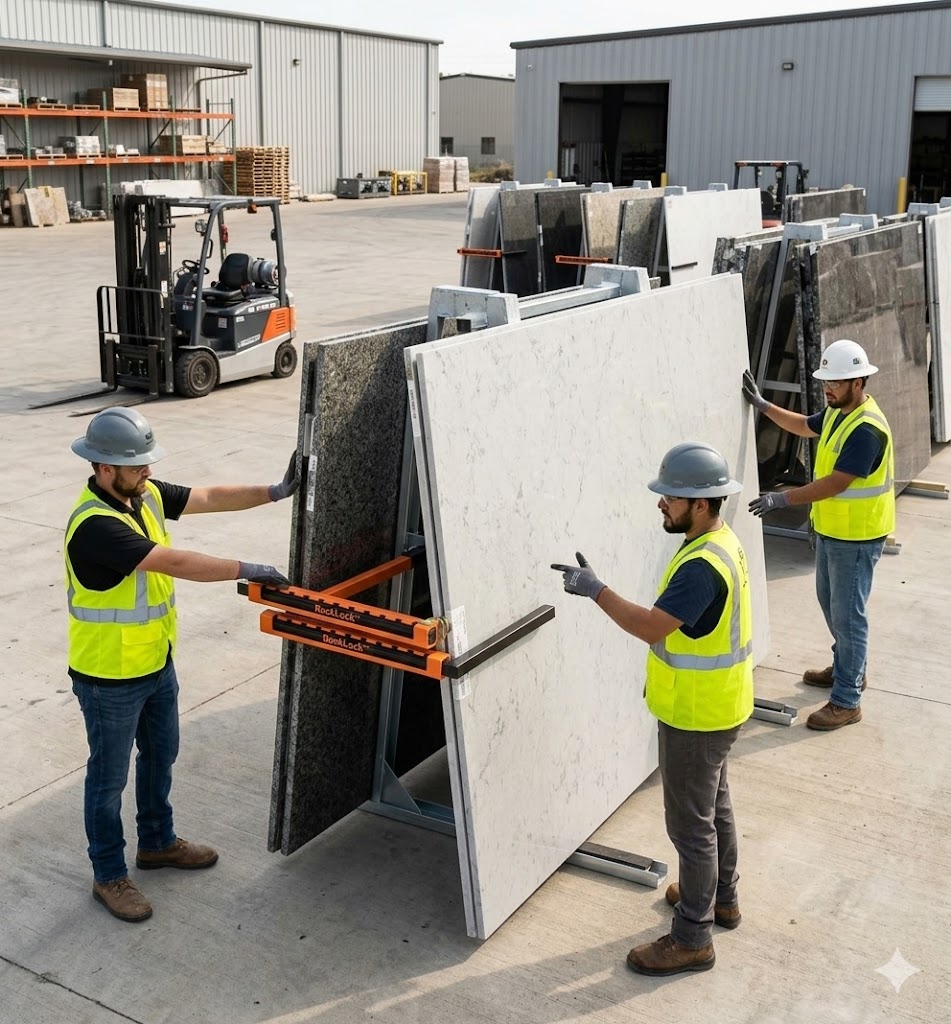
The stone industry has invested heavily in warehouse safety, transport restraint, and material handling training. Those investments matter. But the evidence is clear that the point of greatest risk is not where slabs are stored or even where they travel. It's where they're placed — at the jobsite, during installation, when every variable is least controlled.
Reducing installer slab injuries requires acknowledging that human strength and attention are finite resources that deplete over a workday. Effective jobsite safety means building systems that perform consistently regardless of how many slabs the crew has already handled that day.
RockLock™ installation systems are engineered to provide that consistency: mechanical restraint, controlled movement paths, and predictable slab behavior during the transitions that matter most. The result is reduced physical strain on installers, fewer panic moments, lower liability exposure, and less material damage.
If your current installation process depends entirely on manual control, it may be worth evaluating where mechanical assistance could reduce your crew's exposure to the forces that cause the most common injuries in the trade.
To learn more about how RockLock™ installation frames integrate into existing workflows, contact Safe Stone Handling at safestonehandling.com, email [email protected], or call 866-919-3225.
Safe Stone Handling manufactures engineered slab safety systems featuring the patented RockLock™ mechanical restraint technology. All products are designed and built in Tennessee, USA.
